Do Golf Balls Go Bad Over Time in Storage? (Shelf Life & Science Explained)
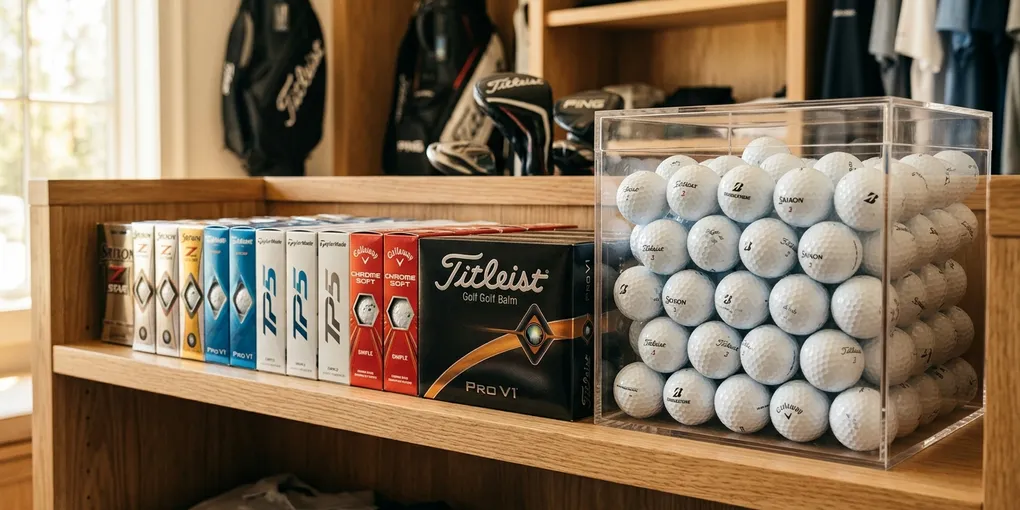
While organizing our garage recently, our daughter stumbled upon a dusty box of golf balls tucked in the back of a closet from five years ago. Her immediate question was: “Can we still play with these, or are they expired?”
It is a question almost every golfer asks when cleaning out a closet or finding an old sleeve in the trunk.
Here is the direct answer: Modern solid-core golf balls do not have an expiration date. If stored at normal room temperature, modern 2-piece, 3-piece, and multi-layer golf balls will retain 99% of their original performance for 7 to 10+ years.
However, how and where you store them matters significantly. Here is the science behind golf ball shelf life, why the “old ball myth” exists, and the three environmental factors that can actually ruin a ball.
Modern Solid-Core vs. Vintage Wound Balls (Why the Myth Exists)
The belief that golf balls “go bad” quickly comes from the 1980s and 1990s when golfers played with wound balata balls.
- Vintage Wound Balls (The Past): Older golf balls were constructed with a liquid-filled center wrapped in tightly wound rubber thread, covered by a soft tree-sap rubber called Balata. Over 12 to 24 months, the internal rubber bands naturally lost elasticity, dried out, and became brittle, causing the ball to lose compression and significant distance.
- Modern Solid-Core Balls (Today): Virtually every golf ball manufactured after the year 2000 uses a solid synthetic core made of high-resilience polybutadiene rubber, encased in durable ionomer (Surlyn) or cast urethane covers. These synthetic polymers are chemically stable and do not degrade under normal conditions.
Whether you are hitting a high-end Titleist Pro V1 or a budget beginner golf ball, a modern ball will easily last a decade on a dry shelf.
Golf Ball Storage Condition Matrix: Shelf Life & Distance Impact
To understand how storage conditions affect performance, here is how different environments impact modern golf balls over time:
| Storage Environment | Average Shelf Life | Estimated Distance & Performance Impact |
|---|---|---|
| Indoor / Climate-Controlled (65°F – 75°F / 18°C – 24°C) | 7 – 10+ Years | 0% loss (virtually identical to factory new) |
| Hot Garage / Car Trunk (Repeated swings over 110°F / 43°C) | 2 – 3 Years | 1% – 3% distance loss (mild core softening/rebound loss) |
| Winter Freezing Garage (Sub-freezing below 32°F / 0°C) | Indefinite | 0% permanent loss (must thaw to room temp before hitting) |
| Submerged in Water / Pond (Over 3 to 6 months) | Under 6 Months | 5 – 15 yards lost (microscopic water penetration into the core) |
The 3 Real Enemies of Golf Ball Shelf Life
While time alone won’t kill a modern golf ball, three specific environmental factors will:
1. Extreme Heat & Repeated Thermal Cycling
Leaving golf balls in the trunk of your car during hot summer months is the most common way golfers unintentionally damage their gear. When trunk temperatures exceed 120°F (49°C), the polybutadiene core experiences thermal breakdown over time. This softens the core and reduces its coefficient of restitution (COR), robbing you of 3 to 5 yards off the tee.
2. Moisture and Water Submersion (The Lake Ball Trap)
Golf ball covers look solid, but on a microscopic level, polymers are semi-permeable. If a ball sits underwater in a course hazard for several months, water molecules slowly seep through the dimpled cover into the core.
This water logging permanently destroys the core’s energy transfer. Tests show that “lake balls” or refurbished balls retrieved from ponds often fly 10 to 15 yards shorter with drivers than dry balls of the exact same model.
3. Direct UV Sunlight Exposure
Leaving loose balls in direct sunlight on a patio or outdoor practice bucket will cause ultraviolet radiation to break down the outer clear coat. While this doesn’t immediately hurt the core, it will turn white covers yellow and make the outer cover more prone to cracking when struck by iron grooves.
Simple At-Home “Bounce Test” for Old Golf Balls
If you found an unmarked stash of golf balls and want to know if they are still good, try this quick test our family uses:
- Grab a brand-new golf ball from your bag as a control benchmark.
- Hold both the new ball and the mystery ball side-by-side at eye level over a hard surface (like a concrete driveway or tile floor).
- Drop them simultaneously without applying downward force.
- Observe the rebound height: If the mystery ball rebounds to the exact same height as the new ball, its core elasticity is 100% intact and it is ready for the golf course. If it rebounds noticeably lower, the core has softened or absorbed moisture.
FAQ: Storing Golf Balls
Can you play golf with cold golf balls in the winter?
You should avoid hitting golf balls while they are physically cold. While freezing temperatures do not permanently damage modern cores, a cold ball is much firmer, compresses less at impact, and travels 3 to 5 yards shorter per 10°F drop in temperature. Keep your balls inside your house the night before a cold morning round.
Are 10-year-old golf balls okay for beginners and junior golfers?
Yes, absolutely. For high-handicap beginners, juniors, and casual players, the slight variance in an older dry ball is completely unnoticeable compared to normal swing mechanics. Save your money and use up that old closet stash for practice rounds and driving range warmups!
What is the best way to store golf balls long-term?
Store your golf balls inside your home in an interior closet, pantry, or finished basement where temperatures stay between 60°F and 75°F (15°C – 24°C) with low humidity. Keep them in their original cardboard sleeves or a dry storage box away from direct sunlight.
Recommended Reading: Explore More Equipment Science
- Why Do You Tee the Ball High for a Driver but Low for an Iron? — The Angle of Attack physics behind driver launch and iron compression.
- Why Do Modern Golf Drivers Make Such a Loud “Ping” Sound? — The acoustic engineering and trampoline physics behind driver impact.
- Why Do Golf Balls Have Dimples? — Discover how tiny craters create lift and cut aerodynamic drag in half.