Why Do Golf Clubs Have Grooves on the Face? (Equipment Science Q&A)
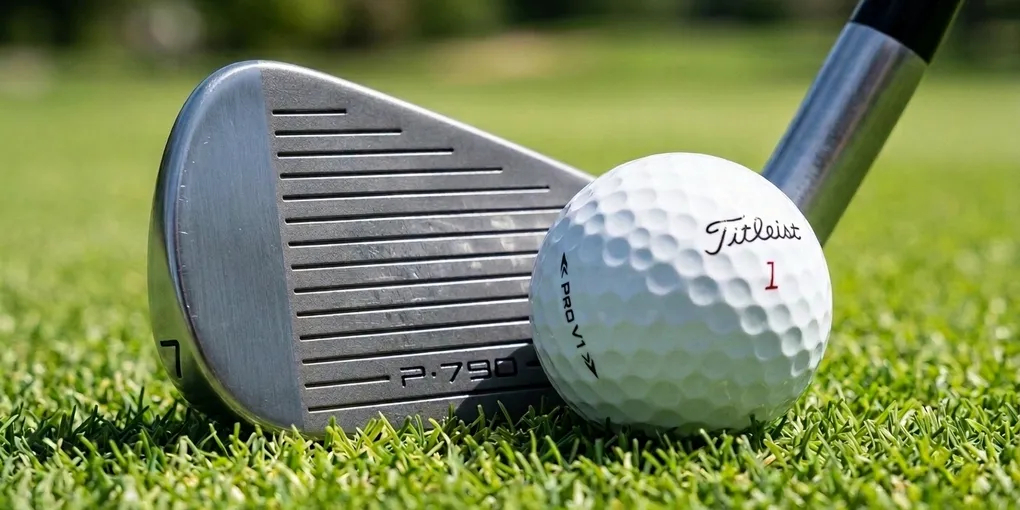
When you first start examining a set of golf clubs, one of the first things you’ll notice is the series of horizontal lines carved into the flat metal face. Our daughter recently asked, “Why aren’t the clubs just completely smooth?”
Just like the dimples on a golf ball, these carved lines—called grooves—are not just there for decoration. They serve a very specific, scientific purpose!
Q: Why do golf clubs have grooves?
A: Grooves act exactly like the treads on a car tire. They channel away grass, dirt, and water so the clubface can make clean contact with the golf ball and create backspin.
Here is the simple science behind how it works:
1. Creating Friction and Spin
To get a golf ball to fly straight and stop quickly when it lands on the green, you need to impart “backspin” on it. When the flat metal face of the club strikes the ball at high speed, the grooves grip the cover of the golf ball. This friction pulls down on the back of the ball, forcing it to spin backward rapidly as it launches into the air.
Without grooves, the clubface would slide against the ball, causing it to launch with very little spin and roll unpredictably when it hits the ground.
2. Channeling Away Moisture (The Tire Tread Effect)
If you play golf early in the morning when there is dew on the grass, or if your ball is sitting deep in the “rough” (long grass), there is a lot of debris between your club and the ball.
If the clubface were perfectly smooth, the water and crushed grass would act like a lubricant, causing the ball to slide wildly off the club (just like a bald car tire hydroplaning on a wet road). The grooves give that water and grass a place to escape, allowing the flat metal between the grooves to still make clean, dry contact with the ball!
Q: Do all golf clubs have the same grooves?
A: No! The grooves change depending on the club.
- Wedges: The clubs you use near the green have the deepest, sharpest grooves. This is because you need maximum spin to force the ball to stop quickly on the putting surface.
- Drivers: The driver (the longest club) has very shallow grooves—or sometimes no grooves in the center at all! Because you are hitting the ball off a wooden tee, there is no grass or water in the way, so deep grooves aren’t as necessary.
Q: Do grooves wear out?
A: Yes, they do.
Over time, hitting thousands of golf balls covered in dirt and sand acts like sandpaper, slowly wearing down the sharp edges of the grooves. When grooves get worn down, you lose the ability to put spin on the ball. This is why professional golfers replace their wedges multiple times a year!
For a beginner, your grooves will easily last for years. Just make sure you keep them clean with a wet towel or a brush so they can do their job properly!
Explore More Golf Equipment Science
- Why Do Modern Golf Drivers Make Such a Loud “Ping” Sound? — The acoustic engineering and trampoline physics behind driver impact.
- Do Golf Balls Go Bad Over Time in Storage? — Learn how temperature and moisture affect golf ball shelf life and distance.
- Why Do Golf Balls Have Dimples? — Discover how tiny craters create lift and cut aerodynamic drag in half.